A question at a recent family reunion urged me to get back to my blog. I have read a book in the past two months , just not a classic.
I read Bear Gryll's autobiography and I really liked it. I'll write more when I'm not typing on an iPhone.
I'm currently reading Conquering the North Face but Hap Klopp. Already laughing and agreeing with his observations about business.
July 13, 2012

May 22, 2012
Jon McLaughlin--McLovers Contest Entry
A few weeks ago I created a post promoting Jon McLaughlin's new CD and tour, Promising Promises. The CD was released today! So excited to listen to it (right after I finish this entry and watch the finale of American Idol). Finally I finished my entry for the McLover's contest; it's a quilt...yes, that's right. I made a t-shirt quilt by using the promotional poster printed on iron-on fabric. I call it my Mini McLaughlin McLover's Quilt. It's four foot square and somewhat symmetrical. The thing about using t-shirts as fabric is that once you cut it, it rolls...and the older the shirt, the more it rolls (but the softer it is ;). But the great thing about quilts is that they are lovable precisely because they aren't perfect.


Below is the link to view my YouTube video submission for the contest. Note: I am not savvy at film editing nor do I particularly like taking videos of myself because I think it never looks like me, but I digress...you know what I mean ;)
What's at stake? A couple tickets to the Indianapolis show at The Vogue, a chance to meet Jon and a CD. Even if I don't win, it was fun to make the quilt and learn about the fabric I can print on (sweet projects in the future). As you'll see, I also offered to send Jon the quilt because I'm pretty sure my husband won't use it at home ;)
Here's a picture of the quilt; I also made a pillowcase to accompany the quilt; it's made from a western shirt--open the pillowcase like you open the shirt and voila!


May 6, 2012
A Plug for Promising Promises by Jon McLaughlin
Anyone who knows me well knows I love music, I love classical music, I love many different genres of music and I love Jon McLaughlin's music. My sister and I have tried to make it to as many local concerts when he's in Indianapolis since we saw him at Anderson way back in the day when our brother played ball there. I appreciate the piano-laden songs the most--anyone can synthesize their way through a song but not everyone can PLAY like Mr. McLaughlin--and it's so worth seeing him in concert.
So with this background in place, I'm using my blog as a marketing site today to say BUY JON'S NEW CD, PROMISING PROMISES! The title song, btw, is my favorite, a close second to Industry. He's also on tour this summer and I'm already looking forward to the concert at Conner Prairie. Wine, chocolate and good music (all while chilling outside)? Yes, please!
I've even decided to enter his contest (again, those who know me know I don't normally enter contests) so I can attempt to win two free concert tickets. Even now I'm working on my entry (soon to be posted on this blog). I'll wrap this up: buy his new CD, go to a concert and enjoy yourself! All the pertinent information is posted below:
Link to order Jon's new CD, Promising Promises: Jon's New CD
Link to Jon's site to check out stuff and see tour dates: http://www.jonmcl.com/
Link to the McLover's Contest (I'm almost ready to enter): McLover's Link
Jon's Picture (the Tour Poster was ginormous and so in lieu of that...)


So with this background in place, I'm using my blog as a marketing site today to say BUY JON'S NEW CD, PROMISING PROMISES! The title song, btw, is my favorite, a close second to Industry. He's also on tour this summer and I'm already looking forward to the concert at Conner Prairie. Wine, chocolate and good music (all while chilling outside)? Yes, please!
I've even decided to enter his contest (again, those who know me know I don't normally enter contests) so I can attempt to win two free concert tickets. Even now I'm working on my entry (soon to be posted on this blog). I'll wrap this up: buy his new CD, go to a concert and enjoy yourself! All the pertinent information is posted below:
Link to order Jon's new CD, Promising Promises: Jon's New CD
Link to Jon's site to check out stuff and see tour dates: http://www.jonmcl.com/
Link to the McLover's Contest (I'm almost ready to enter): McLover's Link
Jon's Picture (the Tour Poster was ginormous and so in lieu of that...)
The Great Gatsby
I'm back, more importantly, I finally read The Great Gatsby this weekend. First impression? I really appreciate Fitzgerald's imagery. I find it so much more fun as a reader to "see" every detail of the novel in my mind's eye. I'm also not a fan of Daisy at all--I think she's a tragic waif. Sounds harsh, doesn't it? Well, I agree with Nick by the novel's end that she and Tom are full of utter carelessness. I also found the novel full of tragic irony. It's Gatsby who gets it in the end, Tom and Daisy are off Scott-free (with the exception of what I hope are sleepless nights forever for Daisy's idiocy) and Wilson kills the only man who was probably ever nice to him when he stopped to get gas!
Last time I read this book was sometime between 7th and 10th grade...honestly I don't remember exactly. It's on the sophomore reading list at a local private school here (good to have teenage neighbors) but that entire time period in my life is fuzzy and nondescript (and it's OK to leave it that way). Of course I remember the general story and how can you forget Robert Redford's portrayal of Gatsby (sans the horrid Aquanet-hair circa 1974)?
What I realized is that I find this novel more appealing and parts of it more identifiable as an adult versus being a teen. I didn't go to parties in high school, so how was I supposed to find humor when someone got tanked and a woman ended up crying her heart out at karaoke? College was a different story. Like Nick, one of my more amusing pastimes in college was to be the silent observer at the parties...taking in the hilarity produced by imbibing an exorbitant amount of alcohol. The party descriptions in this novel are wonderful; I can almost imagine myself on the sandy beaches of Gatsby's mansion wearing chiffon and a cloche while sipping a gin and tonic. Sounds great about now, actually...
I would be lying if I didn't (like most everyone has at some time or another) admit that I've driven by enormous homes with amenities far and wide, wondering what it would be like to be on the guest list for a soiree on a Summer's eve. But also like Nick, I hope that my Mid-Western roots would be strong enough to ground me against the endless frivolity and carelessness of the uber-wealthy such as Daisy and Tom. Unfortunately, I would agree that at least in my life's experience I've found to be true more often than not that money doesnt' buy happiness and money doesn't guarantee manners or a conscience.
So now that I've re-read an American classic, I look forward to the re-make of the film out Christmas Day, 2012. I think Leo will be a convincing Gatsby, don't you?

Last time I read this book was sometime between 7th and 10th grade...honestly I don't remember exactly. It's on the sophomore reading list at a local private school here (good to have teenage neighbors) but that entire time period in my life is fuzzy and nondescript (and it's OK to leave it that way). Of course I remember the general story and how can you forget Robert Redford's portrayal of Gatsby (sans the horrid Aquanet-hair circa 1974)?
What I realized is that I find this novel more appealing and parts of it more identifiable as an adult versus being a teen. I didn't go to parties in high school, so how was I supposed to find humor when someone got tanked and a woman ended up crying her heart out at karaoke? College was a different story. Like Nick, one of my more amusing pastimes in college was to be the silent observer at the parties...taking in the hilarity produced by imbibing an exorbitant amount of alcohol. The party descriptions in this novel are wonderful; I can almost imagine myself on the sandy beaches of Gatsby's mansion wearing chiffon and a cloche while sipping a gin and tonic. Sounds great about now, actually...
I would be lying if I didn't (like most everyone has at some time or another) admit that I've driven by enormous homes with amenities far and wide, wondering what it would be like to be on the guest list for a soiree on a Summer's eve. But also like Nick, I hope that my Mid-Western roots would be strong enough to ground me against the endless frivolity and carelessness of the uber-wealthy such as Daisy and Tom. Unfortunately, I would agree that at least in my life's experience I've found to be true more often than not that money doesnt' buy happiness and money doesn't guarantee manners or a conscience.
So now that I've re-read an American classic, I look forward to the re-make of the film out Christmas Day, 2012. I think Leo will be a convincing Gatsby, don't you?
April 1, 2012
Intermission
I didn't read either The Great Gatsby or A Wrinkle in Time this month; I could list reasons for why I didn't read but that's not important really...
Much happened this month--many things that will change my next few months to make them busy and full of learning. I start a new job in a week and start a new class in a week as well. I'm excited and ready to learn. I'll be traveling more and meeting many new people.
So for now, I'm putting a pause on this blog--if you've read, thank you :)
Much happened this month--many things that will change my next few months to make them busy and full of learning. I start a new job in a week and start a new class in a week as well. I'm excited and ready to learn. I'll be traveling more and meeting many new people.
So for now, I'm putting a pause on this blog--if you've read, thank you :)
March 12, 2012
If by Rudyard Kipling
IF
If you can keep your head when all about you
Are losing theirs and blaming it on you;
If you can trust yourself when all men doubt you,
But make allowance for their doubting too:
If you can wait and not be tired by waiting,
Or, being lied about, don't deal in lies,
Or being hated don't give way to hating,
And yet don't look too good, nor talk too wise;
If you can dream---and not make dreams your master;
If you can think---and not make thoughts your aim,
If you can meet with Triumph and Disaster
And treat those two impostors just the same:.
If you can bear to hear the truth you've spoken
Twisted by knaves to make a trap for fools,
Or watch the things you gave your life to, broken,
And stoop and build'em up with worn-out tools;
If you can make one heap of all your winnings
And risk it on one turn of pitch-and-toss,
And lose, and start again at your beginnings,
And never breathe a word about your loss:
If you can force your heart and nerve and sinew
To serve your turn long after they are gone,
And so hold on when there is nothing in you
Except the Will which says to them: "Hold on!"
If you can talk with crowds and keep your virtue,
Or walk with Kings---nor lose the common touch,
If neither foes nor loving friends can hurt you,
If all men count with you, but none too much:
If you can fill the unforgiving minute
With sixty seconds' worth of distance run,
Yours is the Earth and everything that's in it,
And---which is more---you'll be a Man, my son!
http://www.poemhunter.com/poem/if/
If you can keep your head when all about you
Are losing theirs and blaming it on you;
If you can trust yourself when all men doubt you,
But make allowance for their doubting too:
If you can wait and not be tired by waiting,
Or, being lied about, don't deal in lies,
Or being hated don't give way to hating,
And yet don't look too good, nor talk too wise;
If you can dream---and not make dreams your master;
If you can think---and not make thoughts your aim,
If you can meet with Triumph and Disaster
And treat those two impostors just the same:.
If you can bear to hear the truth you've spoken
Twisted by knaves to make a trap for fools,
Or watch the things you gave your life to, broken,
And stoop and build'em up with worn-out tools;
If you can make one heap of all your winnings
And risk it on one turn of pitch-and-toss,
And lose, and start again at your beginnings,
And never breathe a word about your loss:
If you can force your heart and nerve and sinew
To serve your turn long after they are gone,
And so hold on when there is nothing in you
Except the Will which says to them: "Hold on!"
If you can talk with crowds and keep your virtue,
Or walk with Kings---nor lose the common touch,
If neither foes nor loving friends can hurt you,
If all men count with you, but none too much:
If you can fill the unforgiving minute
With sixty seconds' worth of distance run,
Yours is the Earth and everything that's in it,
And---which is more---you'll be a Man, my son!
http://www.poemhunter.com/poem/if/
March 7, 2012
C.S. Lewis
What does C.S. Lewis have to do with my reading selections this month? Nothing, really. It's just that I am finishing up reading Mere Christianity which he wrote several decades ago before I start my other selection. I like it. It's one of those books that makes you think; actually, it hurts to think when you read this book--but it's a good hurt. I will likely have to re-read it sometime as it's topic is rich and deals with the heart of matter--what does one really believe in?
Want to learn more about C.S. Lewis and Mere Christianity? Click on the links below.
C. S. Lewis
Mere Christianity
Want to learn more about C.S. Lewis and Mere Christianity? Click on the links below.
C. S. Lewis
Mere Christianity
March 5, 2012
March Madness

I've never read A Wrinkle in Time, but it was the winner of the 1963 Newbery Medal; I hear it's a fun, easy read--exactly what I need after Hugo.
The really important question, however, is: Will Leo be better than Redford? Oooo, tough one.


February 29, 2012
Surrender
Can you see it? That tiny white spot on the horizon? That's me; I'm waiving the white flag of surrender. Like a wild animal caught in quicksand, I could not escape the details of Parisian city planning and died a slow death of boredom mixed with lethargy...sorry Victor...
Any suggestions for March's classic?
Any suggestions for March's classic?
February 26, 2012
Reader's Block
Is it possible to have reader's block? I can't make myself read any more of the The Hunchback of Notre Dame, I just can't do it. Maybe I should just read the Sparknotes instead? Notre Dame de Paris--the Shortcut via Sparknotes. I'm sitting at B&N, no husband or dogs to impose on my time and I'm typing this instead. I read Death Comes to Pemberley in about a day, and that was with sleep and work counted in those hours and it was so easy. Unfortunately, not so easy with this novel. I really want to finish the novel because I don't like to miss a goal once stated...but I hate being forced to read something...even if it's only me forcing myself. Did I read a novel this month? Yes, yes I did; was it a classic? No, not yet at least. My husband and friends tell me to read whatever I want to since it is my blog. I almost rather read my Accounting book again...almost. Three days remain...
On a completely different note, I recently looked at a magazine on the stands directly opposite me and this was it's cover page: Note: as a nutrition educator, I find this disturbing...

On a completely different note, I recently looked at a magazine on the stands directly opposite me and this was it's cover page: Note: as a nutrition educator, I find this disturbing...
February 24, 2012
Intermission--Death Comes to Pemberley
I had to take a break; I had to take a break from reading The Hunchback. I told a co-worker today that I have had a new book sitting on my desk to read for the last three weeks--and I really wanted to read it. It's borrowed from the library, due this Saturday and I can't renew it. Furthermore I found out I was request #168 on the list to get it again. Since I try not to buy books I know I can rent from the library, I had to make an executive decision.
I'm letting the details of Parisian architecture in the later Medieval period rest for a couple days while I read Death Comes to Pemberley, (read more quickly and with a greater desire) a novel intertwining the supposed future lives of Elizabeth Bennet and Fitzwilliam Darcy from Jane Austen's Pride and Prejudice with a murder that occurs within the creepy woodlands on their estate the eve of Lady Anne's Ball. I am a much happier reader at the moment, I must admit. I was becoming caked with mud trudging through the mire of copious details (no offence Hugo). I'm nearly a third of the way through the novel already, voraciously absorbing the Georgian period details I love to learn about.
Just for the fun of it, let's remember the famous lake scene from the 1995 miniseries (that never happened in the book but that skyrocketed Colin Firth's career).
I'm letting the details of Parisian architecture in the later Medieval period rest for a couple days while I read Death Comes to Pemberley, (read more quickly and with a greater desire) a novel intertwining the supposed future lives of Elizabeth Bennet and Fitzwilliam Darcy from Jane Austen's Pride and Prejudice with a murder that occurs within the creepy woodlands on their estate the eve of Lady Anne's Ball. I am a much happier reader at the moment, I must admit. I was becoming caked with mud trudging through the mire of copious details (no offence Hugo). I'm nearly a third of the way through the novel already, voraciously absorbing the Georgian period details I love to learn about.
Just for the fun of it, let's remember the famous lake scene from the 1995 miniseries (that never happened in the book but that skyrocketed Colin Firth's career).
February 23, 2012
Le Cour de Miracles
Dante's seven levels of hell--that's what our poetic protagonist falls into running through (and finding himself lost in) the streets of Paris after recovering from Quasimodo's fist in his face.
Interesting note at this junction: I'm nearly finished with book three of the novel (over 100 pages) and I realized that this book is not at all like the movies we see growing up. Quasimodo has only been mentioned a couple times; this book is about Pierre Gringoire and the architecture of Paris, specifically Notre Dame cathedral. As a matter of fact, I just finished reading an entire chapter dedicated to the architecture of Notre Dame cathedral and Hugo's passionate feelings as to the defacement put upon the structure via time, wars and sovereigns. The next chapter is all about Paris's aerial view and city planning. VERY different from my prior knowledge of the novel.
Pierre ends up in a nasty part of Paris--the Cour de Miracles, so named due to the beggars and thieves who use trickery to feign physical injuries to earn money. Each night after a day of asking for alms these "tramps" living in the Kingdom of Slang take off their mutilated limbs and imbibe till morning. Unfortunately for Pierre, they don't warm to bourgeoisie like him and so he finds himself in a sticky situation; he must perform a simple task. He can either silently steal a coin from a dummy's pocket without making tiny bells ring (that have been sewn to his clothing) or he can be hanged. Poor Pierre--he fails miserably and faces the noose. A moment before his young life is about to be stifled, Esmeralda offers to marry him.
Marry him? Apparently the custom amongst gypsies is to offer a dying man to any woman who will take him. Lucky for him, Esmeralda was in a sympathetic mood; they "break the jug" and it falls to four pieces--the number of years they are to be wed. She takes him home and he's dumbfounded, though still a man, and tries to "make good" on his rights as a husband. She pulls a knife on him, he relents, asks for food and they talk of their families. We learn that Pierre is an orphan taken in by an abbot for the cathedral and has not a penny to his name. Finally, Esmeralda disappears and Pierre finally finds a place to sleep for the night atop an old dresser.

Interesting note at this junction: I'm nearly finished with book three of the novel (over 100 pages) and I realized that this book is not at all like the movies we see growing up. Quasimodo has only been mentioned a couple times; this book is about Pierre Gringoire and the architecture of Paris, specifically Notre Dame cathedral. As a matter of fact, I just finished reading an entire chapter dedicated to the architecture of Notre Dame cathedral and Hugo's passionate feelings as to the defacement put upon the structure via time, wars and sovereigns. The next chapter is all about Paris's aerial view and city planning. VERY different from my prior knowledge of the novel.
Pierre ends up in a nasty part of Paris--the Cour de Miracles, so named due to the beggars and thieves who use trickery to feign physical injuries to earn money. Each night after a day of asking for alms these "tramps" living in the Kingdom of Slang take off their mutilated limbs and imbibe till morning. Unfortunately for Pierre, they don't warm to bourgeoisie like him and so he finds himself in a sticky situation; he must perform a simple task. He can either silently steal a coin from a dummy's pocket without making tiny bells ring (that have been sewn to his clothing) or he can be hanged. Poor Pierre--he fails miserably and faces the noose. A moment before his young life is about to be stifled, Esmeralda offers to marry him.
Marry him? Apparently the custom amongst gypsies is to offer a dying man to any woman who will take him. Lucky for him, Esmeralda was in a sympathetic mood; they "break the jug" and it falls to four pieces--the number of years they are to be wed. She takes him home and he's dumbfounded, though still a man, and tries to "make good" on his rights as a husband. She pulls a knife on him, he relents, asks for food and they talk of their families. We learn that Pierre is an orphan taken in by an abbot for the cathedral and has not a penny to his name. Finally, Esmeralda disappears and Pierre finally finds a place to sleep for the night atop an old dresser.

February 22, 2012
Unique Chapter Titles
My recent reading made me laugh; Hugo is quite creative in his choice of chapter titles. For instance, Chapter IV of book two: "The Unfortunate Consequences of Following a Pretty Girl in the Street at Night." It's specific, that's for sure. Or, how about this one: "From Charybdis into Scylla." What does this mean? Well, Charybdis was a once-beautiful Greek nymph who was turned into a sea monster. On the other side the narrow strait where she lived was Scylla, a second horrible monster with four eyes. Essentially, a sailor in a bind would be between a Charybid and a Scylla...or a rock and a hard place. Bravo Hugo for your creativity! Poor Gringoire, in our story, is the fellow down on his luck, attempting to find a place to rest his weary, ego-deflated head with the failure of his morality play.
Gringoire ends up wandering throughout Paris, unable to return home because he's behind on rent. Driven by a desire to get as far away from the parade of the Feast of Fools, he takes alleyways and shortcuts through some questionable parts of Paris. Hugo uses this time to reflect upon the architecture of Paris and its change since the setting of the novel. He detests the destruction of buildings with the passing of the Renaissance, Bastille Day and most recently the Industrial Revolution. He mourns the loss of great buildings and the character they created.
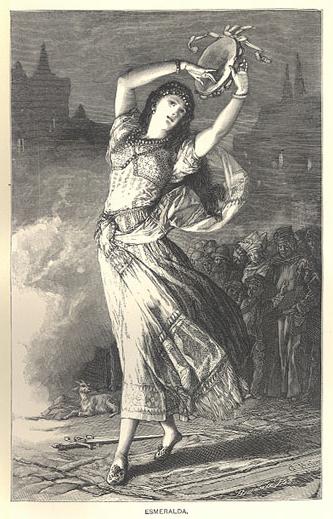
Meanwhile, the Feast of Fools parade has been meandering through the wards of Paris, drawing like a magnet to it thieves, bums and general riff-raff. Quasimodo is still atop his perch, basking in what little notice he's likely ever garnered with revelry in his quiet life. The parade enters a square where Esmeralda is performing with Djali; as expected during this time, Djali is a trianed goat, but an abott in the crowd accuses her of sorcery. The rest of the crowd, however, loves her performance and Gringoire, as expected, is mesmerized by her femninity and exoticism. Esmeralda eventually finishes her performances, collects the coins tossed at her by the crowd and hastily exits to avoid the piercing eyes of the abbott.
Gringoire, continuing on his journey to find a plot of land to rest upon stumbles upon Esmeralda, walking swiftly and deftly through the streets with Djali. He follows her, intrigued by her beauty but also by his curiosity. Esmeralda senses Gringoire's presence and hastens her step but is abruptly cut off by none other than the demenaing abbott and Quasimodo. Quasimodo grabs her, strong as an ox, flattening Gringoire's futile attempt to rescue her with the back of his hand. With Gringoire on the ground and Esmeralda desperately fighting for freedom, the abbot turns to the alley but his escape is stopped by memebers of the Paris police who free Esmeralda and capture Quasimodo. The abbot and Esmeralda run away and Gringoire is left to his wounds in the cold streets of a Parisian gutter.

Gringoire ends up wandering throughout Paris, unable to return home because he's behind on rent. Driven by a desire to get as far away from the parade of the Feast of Fools, he takes alleyways and shortcuts through some questionable parts of Paris. Hugo uses this time to reflect upon the architecture of Paris and its change since the setting of the novel. He detests the destruction of buildings with the passing of the Renaissance, Bastille Day and most recently the Industrial Revolution. He mourns the loss of great buildings and the character they created.
Meanwhile, the Feast of Fools parade has been meandering through the wards of Paris, drawing like a magnet to it thieves, bums and general riff-raff. Quasimodo is still atop his perch, basking in what little notice he's likely ever garnered with revelry in his quiet life. The parade enters a square where Esmeralda is performing with Djali; as expected during this time, Djali is a trianed goat, but an abott in the crowd accuses her of sorcery. The rest of the crowd, however, loves her performance and Gringoire, as expected, is mesmerized by her femninity and exoticism. Esmeralda eventually finishes her performances, collects the coins tossed at her by the crowd and hastily exits to avoid the piercing eyes of the abbott.
Gringoire, continuing on his journey to find a plot of land to rest upon stumbles upon Esmeralda, walking swiftly and deftly through the streets with Djali. He follows her, intrigued by her beauty but also by his curiosity. Esmeralda senses Gringoire's presence and hastens her step but is abruptly cut off by none other than the demenaing abbott and Quasimodo. Quasimodo grabs her, strong as an ox, flattening Gringoire's futile attempt to rescue her with the back of his hand. With Gringoire on the ground and Esmeralda desperately fighting for freedom, the abbot turns to the alley but his escape is stopped by memebers of the Paris police who free Esmeralda and capture Quasimodo. The abbot and Esmeralda run away and Gringoire is left to his wounds in the cold streets of a Parisian gutter.
February 20, 2012
The Fickleness of Humanity
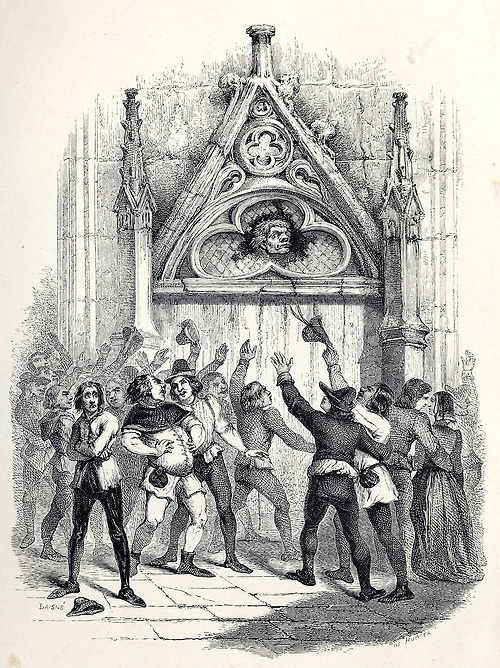
Gringoire, our zealous poet, has little success in trying to turn the crowd's attention back to his morality play once the Flemish dignitaries and the Cardinal enter the Palais de Justice. In fact, the energy of the play peters out in favor of a Flemish celebratory custom, suggested by Coppenhole--a gregarious, boisterous Flemish attendant. This custom? The choosing of a Pope of Fools; this Pope of Fools is decided upon by the crowd; the honor is bestowed upon the person who can conjure up the ugliest grimace through a window or cutout.
So, as expected with a rowdy crowd of Parisians in a small place, they ignore the play entirely (much to Gringoire's chagrin) and set up a makeshift "window" and take volunteers for the grimacing contest. Gringoire relentless urges the actors to shot their lines over the noise of the crowd but has to resign to the fact it's a hopeless endeavor. While he's mourning the loss of his play's moment with the attention of VIP's the crowd is hooting an hollaring at the parade of grmances made for their amusement. A final grimace appearing in the window ensures his victory with the comments of onlookers:
"Oh! the ugly ape!"
"It is the devil himself!"
"It is Quasimodo, the bell ringer!
"Oh, the ugly hunchback!"
And this is how Hugo introduces the reader to Quasimodo, a reclusive bell-ringer of Notre Dame cathedral. Not only is Quasimodo "miraculously ugly, with a horshoe mouth, a horny lip and full of melancholy" he is deaf. One might think the crowd prone to a twinge of guilt by so blatantly making fun of a man whose face is permanently set in a grimace...but not this crowd. As if a slight breeze blew the hall, ruffling only a few whips of hair and causing momentairly delay, the crowd quickly dismissed this minor detail and crowns him the Pope of Fools, dresses him in the "pasteboard tiara and mock robe" and perches him atop a litter carried by twelve officers of the Fraternity of Fools. Quasimodo has but no choice to be paraded now through the galleries and out into the street.
The end of Book I introduces us to La Esmeralda, who, juding from the reactions of men in her general vicinty, is very easy on the eyes. "This pronouncement (of La Esmeralda) produced a magical effect. All who were in the hall ran to the windows, clambering up the walls to obtain a view. Thunderous applause arose at the same moment from the square." We are left wondering, as Gringoire puts it, "what do they mean (by shouting the name) La Esmeralda? It must surly be Egyptique!"

So, as expected with a rowdy crowd of Parisians in a small place, they ignore the play entirely (much to Gringoire's chagrin) and set up a makeshift "window" and take volunteers for the grimacing contest. Gringoire relentless urges the actors to shot their lines over the noise of the crowd but has to resign to the fact it's a hopeless endeavor. While he's mourning the loss of his play's moment with the attention of VIP's the crowd is hooting an hollaring at the parade of grmances made for their amusement. A final grimace appearing in the window ensures his victory with the comments of onlookers:
"Oh! the ugly ape!"
"It is the devil himself!"
"It is Quasimodo, the bell ringer!
"Oh, the ugly hunchback!"
And this is how Hugo introduces the reader to Quasimodo, a reclusive bell-ringer of Notre Dame cathedral. Not only is Quasimodo "miraculously ugly, with a horshoe mouth, a horny lip and full of melancholy" he is deaf. One might think the crowd prone to a twinge of guilt by so blatantly making fun of a man whose face is permanently set in a grimace...but not this crowd. As if a slight breeze blew the hall, ruffling only a few whips of hair and causing momentairly delay, the crowd quickly dismissed this minor detail and crowns him the Pope of Fools, dresses him in the "pasteboard tiara and mock robe" and perches him atop a litter carried by twelve officers of the Fraternity of Fools. Quasimodo has but no choice to be paraded now through the galleries and out into the street.
The end of Book I introduces us to La Esmeralda, who, juding from the reactions of men in her general vicinty, is very easy on the eyes. "This pronouncement (of La Esmeralda) produced a magical effect. All who were in the hall ran to the windows, clambering up the walls to obtain a view. Thunderous applause arose at the same moment from the square." We are left wondering, as Gringoire puts it, "what do they mean (by shouting the name) La Esmeralda? It must surly be Egyptique!"
February 16, 2012
"Monstrously Overburdened with Details"
"Hugo's descriptions of Parisian places is monstrously overburdened with details." If you recall from my last post (which, yes, was over a week ago) you'll recall this quote from the translator on Hugo's architectural flair for descriptive-ness. Let's just say she was acutely accurate; however, I will say that I have excellent fodder for creatively imagining the setting in which this novel takes place.
I've trudged through a mire of extensive detail of the Palais de Justice, (below) the central figure of the first few chapters of The Hunchback. Our narrator describes for us a cacophony of Parisian plebs in celebratory mood as it's the Feast of Fools, a day in the life of medieval Paris that allows the masses to sarcastically insult the bourgeoisie.
All are gathered to the great hall of the palace to watch a "morality play." Hugo provides a thorough description of the play's author, Pierre Gringoire, a "blonde, tall and slender, pale, still young, with sparkling eyes and smiling lips." Hugo gives ample text to miniature stories happening simultaneously--Pierre charming two nubile French maids, a beggar annoying the play's actors, the pompous entrace of the Cardinal and the Flemish dignatries (for which the play is being performed) and descriptions of the energetic young men shouting inflammatory comments to the clergy, much to the audience's cheer.
I will admit that in only a few pages I already have a vivid and detailed image of the setting for this novel. I will also admit it takes some energy to make it through the details!

I've trudged through a mire of extensive detail of the Palais de Justice, (below) the central figure of the first few chapters of The Hunchback. Our narrator describes for us a cacophony of Parisian plebs in celebratory mood as it's the Feast of Fools, a day in the life of medieval Paris that allows the masses to sarcastically insult the bourgeoisie.
All are gathered to the great hall of the palace to watch a "morality play." Hugo provides a thorough description of the play's author, Pierre Gringoire, a "blonde, tall and slender, pale, still young, with sparkling eyes and smiling lips." Hugo gives ample text to miniature stories happening simultaneously--Pierre charming two nubile French maids, a beggar annoying the play's actors, the pompous entrace of the Cardinal and the Flemish dignatries (for which the play is being performed) and descriptions of the energetic young men shouting inflammatory comments to the clergy, much to the audience's cheer.
I will admit that in only a few pages I already have a vivid and detailed image of the setting for this novel. I will also admit it takes some energy to make it through the details!
_June_2010.jpg)
February 8, 2012
Course Adjustment
I haven't even started reading Les Miserables yet; I'm not feeling it this month. So I'm making an executive decision: I've decided to read The Hunchback of Notre Dame instead. Still Hugo, still French but (and thankfully) shorter in length and not the weight of a small child. I know for certain I have yet to read The Hunchback, unlike my ambiguity on whether I read Les Miserables.
I find the following statement from this edition's translator both encouraging and intriguing: "I have made the novel more accessible to a contemporary audience, but I have also made the original translation with all its mistakes and prejudices disappear...(the previous translation) was hasty and prudish to the extreme. The reader will be more shocked by Hugo's obvious prejudices against minorities. Architecture is the real hero of the novel as Hugo's descriptions of Parisian places is monstrously overburdened with details."
I have a feeling this translation of the novel will not follow Disney's idealistic interpretation...

I find the following statement from this edition's translator both encouraging and intriguing: "I have made the novel more accessible to a contemporary audience, but I have also made the original translation with all its mistakes and prejudices disappear...(the previous translation) was hasty and prudish to the extreme. The reader will be more shocked by Hugo's obvious prejudices against minorities. Architecture is the real hero of the novel as Hugo's descriptions of Parisian places is monstrously overburdened with details."
I have a feeling this translation of the novel will not follow Disney's idealistic interpretation...
February 2, 2012
Les Miserables...or Mes Miserables?
Would it be a sacrilege to watch Les Miserables before I read the novel? Yes, I know, it would be; I just wish I could remember if I read it in school or not--and that is why I should read it. It's a beast of a novel unabridged; perhaps I should try and find a large print version? No, that won't work...then it will only be longer!
What if I were to sing all the songs from Les Miserable, the musical in stead? I sang those in choir years ago. I would much prefer that...can you tell I'm procrastinating? February 2 and I haven't yet started to read it. That means I only have 27 days to read it; this means I would need to read an average number of 54 pages a day. Yikes. Well, let's hope I become engrossed in the novel and don't notice pages 100, 200...
Did you know there is a "Forever Young" official Les Miserables Tour website? Les Miserables. I'm more excited that there is a remake set to arrive in 2012 starring Russel Crowe and Hugh Jackman (yes, please) Les Miserables 2012. Though I have to give props to Liam Neeson, Claire Danes and Geoffrey Rush for the 1998 version.

What if I were to sing all the songs from Les Miserable, the musical in stead? I sang those in choir years ago. I would much prefer that...can you tell I'm procrastinating? February 2 and I haven't yet started to read it. That means I only have 27 days to read it; this means I would need to read an average number of 54 pages a day. Yikes. Well, let's hope I become engrossed in the novel and don't notice pages 100, 200...
Did you know there is a "Forever Young" official Les Miserables Tour website? Les Miserables. I'm more excited that there is a remake set to arrive in 2012 starring Russel Crowe and Hugh Jackman (yes, please) Les Miserables 2012. Though I have to give props to Liam Neeson, Claire Danes and Geoffrey Rush for the 1998 version.
January 27, 2012
Winter Duldrums
It's been a week since the last post; I've been pondering which classic to read for February. Am I feeling the vibe for Victor Hugo or Leo Tolstoy? At this particular moment, I'm feeling the need for sun and sand, margaritas and long walks on a beach. Man, I really don't like winter...it's not that I don't like the peace brought about by the brisk mornings. I just don't like my outdoor activity hampered. Having said that, this week I did take a jog at the local nature park, running the trails in the chilly weather on the wet grass and mud. I can only do that when its not sleeting, snowing, misting, raining or generally miserable due to the inconsistent, ever-shifting Indiana weather. Not to mention that due to this change of barometric pressure, my skin is holding on to moisture for dear life. One day its 50 with sun, the next day, 19 with a 0 degree wind chill. OK, enough "poor me" pity language. Tune in next week to see which novel made the cut for February.
The sun just peeked it's glorious face through the clouds for about a minute--only the second time I've seen a glimpse of sunlight in a week. Iprefer this kind of sunny day...

The sun just peeked it's glorious face through the clouds for about a minute--only the second time I've seen a glimpse of sunlight in a week. Iprefer this kind of sunny day...

January 20, 2012
Courage in Death
I've finished reading Beowulf; initial impressions when the last page turned:
1. It wasn't as bad as I anticipated
2. I actually thought it was poetic (fancy that since it's a poem)
3. It consisted of way more than superficial monsters, swords, helmets and characters with too many consonants in their names. Like an onion, it had many thematic layers.
4. I would re-read it to better understand the underlying themes.
5. If I did re-read it, I may consider reading aloud to better understand what it would have been like for this story to be told as it would have been throughout its early history.
We learn in Chapter 32 that the serf who stole the gem-studded cup from the dragon stole it due to need as he was a slave, recently beaten by his master and on the run. However, this fact didn't matter to the dragon. The dragon, peeved at having been disturbed and his treasure disrupted, wrecked a small village, "vomiting smoke and fire, burning down their homes." The Geats plead to Beowulf to help slay the dragon; he agrees and then a couple chapters re-visit family history of his lineage, etc. I noticed the dragon did not have a name as did Grendel. I wonder why?
The action continues with Beowulf, now older and more feeble, feeling the effects of age, despite his unflinching courage. Beowulf makes a final oratory, speaking to his people and soldiers prepared to fight the dragon should duty call: "I've never known fear; as a youth I fought in endless battles. I am old, now, but I will fight again, seek fame still, if the dragon hiding in this tower dares to face me." Talk about "fake it till you make it"...I have to give him credit for his headstrong, if ultimately death-inducing bravery.
So Beowulf and the dragon duke it out; sadly, only one of Beowulf's soldiers--Wiglaf--braves the fiery battle with him when he needs it most. Alas, however, he is too late and Beowulf suffer a fatal jugular wound. They kill the dragon, however, in the end, slicing him in two. Beowulf dies bravely, lying in a puddle of dragon blood on the edge of a cliff near the sea. Wiglaf fufills Beowulf's last wish to gather the dragon-protected treasure for his people and build a huge tower at the very spot of his death so all men may see it and know it as Beowulf's tower to remember his bravery.
Wiglaf reems the soldiers who chickend out and didn't come to their Lord's aid, "death would have been better for you all than the life you'll lead, branded with disgrace!" Our poem ends with a funeral scence on the coast of the Geats, "moaning their sorrows, lamenting their Lord...and so Beowulf's followers rode, mourning their beloved leader, crying that no better king had ever lived, no prince so mild, no man so open to his people, so deserving of praise."
1. It wasn't as bad as I anticipated
2. I actually thought it was poetic (fancy that since it's a poem)
3. It consisted of way more than superficial monsters, swords, helmets and characters with too many consonants in their names. Like an onion, it had many thematic layers.
4. I would re-read it to better understand the underlying themes.
5. If I did re-read it, I may consider reading aloud to better understand what it would have been like for this story to be told as it would have been throughout its early history.
We learn in Chapter 32 that the serf who stole the gem-studded cup from the dragon stole it due to need as he was a slave, recently beaten by his master and on the run. However, this fact didn't matter to the dragon. The dragon, peeved at having been disturbed and his treasure disrupted, wrecked a small village, "vomiting smoke and fire, burning down their homes." The Geats plead to Beowulf to help slay the dragon; he agrees and then a couple chapters re-visit family history of his lineage, etc. I noticed the dragon did not have a name as did Grendel. I wonder why?
The action continues with Beowulf, now older and more feeble, feeling the effects of age, despite his unflinching courage. Beowulf makes a final oratory, speaking to his people and soldiers prepared to fight the dragon should duty call: "I've never known fear; as a youth I fought in endless battles. I am old, now, but I will fight again, seek fame still, if the dragon hiding in this tower dares to face me." Talk about "fake it till you make it"...I have to give him credit for his headstrong, if ultimately death-inducing bravery.
So Beowulf and the dragon duke it out; sadly, only one of Beowulf's soldiers--Wiglaf--braves the fiery battle with him when he needs it most. Alas, however, he is too late and Beowulf suffer a fatal jugular wound. They kill the dragon, however, in the end, slicing him in two. Beowulf dies bravely, lying in a puddle of dragon blood on the edge of a cliff near the sea. Wiglaf fufills Beowulf's last wish to gather the dragon-protected treasure for his people and build a huge tower at the very spot of his death so all men may see it and know it as Beowulf's tower to remember his bravery.
Wiglaf reems the soldiers who chickend out and didn't come to their Lord's aid, "death would have been better for you all than the life you'll lead, branded with disgrace!" Our poem ends with a funeral scence on the coast of the Geats, "moaning their sorrows, lamenting their Lord...and so Beowulf's followers rode, mourning their beloved leader, crying that no better king had ever lived, no prince so mild, no man so open to his people, so deserving of praise."
January 18, 2012
Hell Hath No Fury Like A Mother Scorned...or a Grumpy Dragon
I took a couple days rest from reading Beowulf for the simple fact that I was having incredibly imaginative dreams...a few days rest and I've strengthened my resolve and so far, no more dreams. Let's catch up on the action...
Chapters 16-31 of Beowulf take us from the halls of Herot through the depths of a stinking swamp of slithering sea monsters to the land of the Geats. Time passes quickly as we move from the present to a distant future with Beowulf as King of the Geats. My last post detailed the monstrous (pun intended) coup of Beowulf over Grendel, saving the Danes from imminent death as Grendel's sushi dinner. As expected, King Hrothgar throws a lavish feast in Beowulf's honor, complete with Grendel's bloody appendage hanging from the rafters of Herot.
Herot hall lay silent that night, party-goers under the lull of an excess of wine--that is--until a second monster, Grendel's mother, decides to enact revenge upon Herot: "she brooded on her loss, misery had brewed in her heart...a mother's sad heart, and her greed, drove her on a dangerous pathway of revenge." The she-wolf terrorizes the drunken, peaceful Danes and takes a single victim, the closest friend of King Hrothgar back to her lair in a stinking lake of festering blood and guts.
As you might expect, Hrothgar is stricken with immense sadness that his close friend has now become Momma Monster's sushi. Beowulf then declares (essentially he tells the king not to cry over spilled milk): "Let your sorrow end! It is better for us all to avenge our friends, not mourn them forever. He who can earn it should fight for the glory of his name; fame after death is the noblest of goals." Beowulf agrees to fight her as well, on her territory. He uses his new Hrothgar-given gifts of a chain mail shirt, sword and helmet to prepare for battle with her.
Beowulf delivers a beautiful speech before he jumps into the lake "its waters bloody and bubbling, crawling with snakes." I love how he doesn't drown in this lake as it takes hours to reach the muddy bottom; perhaps he was also born with gills to go with the courage! After a bloody battle, fraught with clawing, ripping, tearing, bleeding and finally, decapitation of the she-wolf, he returns with the head of Grendel as a talisman against future terrors. Hrothgar praises his strength, courage and God-given protection; he heaps booty upon Beowulf, filling his ship with gold, armor, horses and jewels.
Beowulf again makes a great speech on the shores of Denmark, as he prepares to embark on his journey homeward. Unferth (remember him? the jealous Dane?) gifts Beowulf a great Danish sword as a token of his esteem and then the Geats sail home. Awaiting in the homeland is Higlac, the King of the Geats; he is so grateful to the Lord God that Beowulf returned from his journey that once again, a feast was thrown in Beowulf's honor, complete with mead wine, meat and storytelling. Higlac was proud of Beowulf and listened intently to the gory details of the trials and triumphs against the monsters of Denmark.
Our story fast-forwards from this feast and we end chapter 31 fifty years into the future, with Beowulf as King of the Geats, Higlac having long since passed away. What's better than a slimy sea monster to fight? A dragon, of course...and an angry dragon who has been awakened by some errant man who "stumbled upon the dragon's entrance...discovered the ancient treasure and stole a gem-studded cup."
I tried to find an image of Grendel's mother to spice up my posts (because everyone likes pictures). For some reason I feel the first image is a better representation of her than the second (no offense to Angie Jolie, but she's there to sell tickets to the movie).
]


Chapters 16-31 of Beowulf take us from the halls of Herot through the depths of a stinking swamp of slithering sea monsters to the land of the Geats. Time passes quickly as we move from the present to a distant future with Beowulf as King of the Geats. My last post detailed the monstrous (pun intended) coup of Beowulf over Grendel, saving the Danes from imminent death as Grendel's sushi dinner. As expected, King Hrothgar throws a lavish feast in Beowulf's honor, complete with Grendel's bloody appendage hanging from the rafters of Herot.
Herot hall lay silent that night, party-goers under the lull of an excess of wine--that is--until a second monster, Grendel's mother, decides to enact revenge upon Herot: "she brooded on her loss, misery had brewed in her heart...a mother's sad heart, and her greed, drove her on a dangerous pathway of revenge." The she-wolf terrorizes the drunken, peaceful Danes and takes a single victim, the closest friend of King Hrothgar back to her lair in a stinking lake of festering blood and guts.
As you might expect, Hrothgar is stricken with immense sadness that his close friend has now become Momma Monster's sushi. Beowulf then declares (essentially he tells the king not to cry over spilled milk): "Let your sorrow end! It is better for us all to avenge our friends, not mourn them forever. He who can earn it should fight for the glory of his name; fame after death is the noblest of goals." Beowulf agrees to fight her as well, on her territory. He uses his new Hrothgar-given gifts of a chain mail shirt, sword and helmet to prepare for battle with her.
Beowulf delivers a beautiful speech before he jumps into the lake "its waters bloody and bubbling, crawling with snakes." I love how he doesn't drown in this lake as it takes hours to reach the muddy bottom; perhaps he was also born with gills to go with the courage! After a bloody battle, fraught with clawing, ripping, tearing, bleeding and finally, decapitation of the she-wolf, he returns with the head of Grendel as a talisman against future terrors. Hrothgar praises his strength, courage and God-given protection; he heaps booty upon Beowulf, filling his ship with gold, armor, horses and jewels.
Beowulf again makes a great speech on the shores of Denmark, as he prepares to embark on his journey homeward. Unferth (remember him? the jealous Dane?) gifts Beowulf a great Danish sword as a token of his esteem and then the Geats sail home. Awaiting in the homeland is Higlac, the King of the Geats; he is so grateful to the Lord God that Beowulf returned from his journey that once again, a feast was thrown in Beowulf's honor, complete with mead wine, meat and storytelling. Higlac was proud of Beowulf and listened intently to the gory details of the trials and triumphs against the monsters of Denmark.
Our story fast-forwards from this feast and we end chapter 31 fifty years into the future, with Beowulf as King of the Geats, Higlac having long since passed away. What's better than a slimy sea monster to fight? A dragon, of course...and an angry dragon who has been awakened by some errant man who "stumbled upon the dragon's entrance...discovered the ancient treasure and stole a gem-studded cup."
I tried to find an image of Grendel's mother to spice up my posts (because everyone likes pictures). For some reason I feel the first image is a better representation of her than the second (no offense to Angie Jolie, but she's there to sell tickets to the movie).
]
January 14, 2012
Fate Plays A Part
In re-reading my posts to ensure I'm making sense, I realized that Fate plays a big part in Beowulf. Fate has already been mentioned twice in the text:
"Fate will unwind as it must!" and "Fate saves the living when they drive away death by themselves!"
Interestingly enough, Beowulf is credited with both these statements; it becomes clear after this last reading that perhaps Fate did assign qualities to Beowulf alone to defeat Grendel--for that is exactly what happens.
We enter the action, Hrothgar having left Herot in the hands of Beowulf for the evening. As we have learned, Grendel strikes at night, unleashing his horrors and flesh-feasting when the moon is high. Beowulf declares, standing by his bedside and in the presence of his men, that he will fight Grendel not with sword or shield, but with his bare hands. HIS BARE HANDS. And here we see Beowulf's faith: "Let God in His wisdom extend His hand where He wills, reward whom He chooses."
A still, anticipatory silence befalls the Geats and Beowulf as they await the arrival of this devil and perhaps their death. On cue, Grendel re-enters the story, "out of the marsh, bearing God's hatred" slithering his way to Herot to feast upon man-flesh. Grendel snickers at the sight of so many men sleeping, feebly guarding the great hall. He attacks with vengeance the first Geat he lays claw upon, ripping his flesh apart and spilling his innards (yum). He moves to the next slumbering Geat only to be shocked that this man is able to bend back his advancing claws, striking not only surprise but fear into his ghoulish heart.
A weaponless battle ensues and Grendel knows, "that nowhere on earth had he met a man's whose hands were harder...and his mind flooded with fear. He wanted nothing but retreat and escape...but he was trapped." Go team Beowulf! Grendel attempts to free himself, but to no avail, Beowulf's grip is vise-like and unflinching. Finally, our poet states, "Grendel discovered what it meant to feud with Almighty God." Grendel is finally able to escape the halls of Herot but lighter on his feet, for Beowulf ripped off his arm! It is intimated in the text that Grendel wearily returns to his swampish lair, life diminishing from loss of blood and utter powerlessness.
As you can imagine, the Danes are elated that this evil has been destroyed and Grendel's appendage is put on display for all to see. The Danes praise Beowulf's courage and strength, recanting songs of old and creating new songs of Beowulf, who is "well-loved, followed in friendship and not fear." Morning passes quickly and by high noon, King Hrothgar and his wife Welthow visit the hall to see the prize.
"Fate will unwind as it must!" and "Fate saves the living when they drive away death by themselves!"
Interestingly enough, Beowulf is credited with both these statements; it becomes clear after this last reading that perhaps Fate did assign qualities to Beowulf alone to defeat Grendel--for that is exactly what happens.
We enter the action, Hrothgar having left Herot in the hands of Beowulf for the evening. As we have learned, Grendel strikes at night, unleashing his horrors and flesh-feasting when the moon is high. Beowulf declares, standing by his bedside and in the presence of his men, that he will fight Grendel not with sword or shield, but with his bare hands. HIS BARE HANDS. And here we see Beowulf's faith: "Let God in His wisdom extend His hand where He wills, reward whom He chooses."
A still, anticipatory silence befalls the Geats and Beowulf as they await the arrival of this devil and perhaps their death. On cue, Grendel re-enters the story, "out of the marsh, bearing God's hatred" slithering his way to Herot to feast upon man-flesh. Grendel snickers at the sight of so many men sleeping, feebly guarding the great hall. He attacks with vengeance the first Geat he lays claw upon, ripping his flesh apart and spilling his innards (yum). He moves to the next slumbering Geat only to be shocked that this man is able to bend back his advancing claws, striking not only surprise but fear into his ghoulish heart.
A weaponless battle ensues and Grendel knows, "that nowhere on earth had he met a man's whose hands were harder...and his mind flooded with fear. He wanted nothing but retreat and escape...but he was trapped." Go team Beowulf! Grendel attempts to free himself, but to no avail, Beowulf's grip is vise-like and unflinching. Finally, our poet states, "Grendel discovered what it meant to feud with Almighty God." Grendel is finally able to escape the halls of Herot but lighter on his feet, for Beowulf ripped off his arm! It is intimated in the text that Grendel wearily returns to his swampish lair, life diminishing from loss of blood and utter powerlessness.
As you can imagine, the Danes are elated that this evil has been destroyed and Grendel's appendage is put on display for all to see. The Danes praise Beowulf's courage and strength, recanting songs of old and creating new songs of Beowulf, who is "well-loved, followed in friendship and not fear." Morning passes quickly and by high noon, King Hrothgar and his wife Welthow visit the hall to see the prize.
January 12, 2012
The Green-Eyed Monster
What happens when boastful confident men, alcohol and a desperate desire for justice intersect? Fights ensue; in this case, it was a verbal war between Beowulf and a new character, Unferth. (I don't like that name, Unferth...sounds too close to uncouth). Anyway, Beowulf is welcomed into Herot and a feast is thrown in his honor to toast his victories and speak of the future.
Apparently Unferth imbibes a bit too much and speaks "harshly and sharp, vexed by Beowulf's adventure, courage and acquired glory and fame greater than his own." Essentially, Unferth sticks his foot in his mouth and makes Beowulf shine even brighter (if that is at all possible at this point of the story). Unferth calls him a "boastful fool, daring, young and proud, risking his life for no reason but danger" (looks like someone else thinks Beowulf may be bordering on extreme confidence).
Beowulf takes this insult in stride, allowing Unferth to bury himself in his mead-influenced verbiage and then defends himself, "your face is hot with ale and your tongue has tried...but the truth is simple..." What simple truth is this? Only that Beowulf is the only man who can slay multiple sea-monsters with little resources and stay alive. Yes, by Beowulf's own admittance, he is the only man that "can swim in the sea as I can, no strength is a match for mine."
Beowulf states to Unferth and all feasting that he is not boasting, he is simply telling the truth. He unnerves Unferth all the more by stating that he's never heard any impressive stories about him and that no man can match him. We then learn that Unferth is probably a sore loser since he's apparently murdered his own brothers. Beowulf lands a final pride-deafening blow by suggesting that the horror Grendel has inflicted upon Herot is due to a lack of action and strength from Unferth and other "quiet Danes." Burn.
Hrothgar must approve because he offers wine to all present at the feast and his wife, Welthow, passes the goblet round and personally offers Beowulf a drink. King Hrothgar announces that he is glad the Geats have come to save the day and turns over Herot to the visitors (which he's never done). Beowulf, as expected, announces that he knew his purpose "was this: to win the good will of your people or die in battle. Let me live in greatness and courage, or here in this hall welcome my death!"
Hrothgar ends the feasting with these words: "Purge Herot (of Grendel) and your ship will sail home with its treasure-holds full."

Apparently Unferth imbibes a bit too much and speaks "harshly and sharp, vexed by Beowulf's adventure, courage and acquired glory and fame greater than his own." Essentially, Unferth sticks his foot in his mouth and makes Beowulf shine even brighter (if that is at all possible at this point of the story). Unferth calls him a "boastful fool, daring, young and proud, risking his life for no reason but danger" (looks like someone else thinks Beowulf may be bordering on extreme confidence).
Beowulf takes this insult in stride, allowing Unferth to bury himself in his mead-influenced verbiage and then defends himself, "your face is hot with ale and your tongue has tried...but the truth is simple..." What simple truth is this? Only that Beowulf is the only man who can slay multiple sea-monsters with little resources and stay alive. Yes, by Beowulf's own admittance, he is the only man that "can swim in the sea as I can, no strength is a match for mine."
Beowulf states to Unferth and all feasting that he is not boasting, he is simply telling the truth. He unnerves Unferth all the more by stating that he's never heard any impressive stories about him and that no man can match him. We then learn that Unferth is probably a sore loser since he's apparently murdered his own brothers. Beowulf lands a final pride-deafening blow by suggesting that the horror Grendel has inflicted upon Herot is due to a lack of action and strength from Unferth and other "quiet Danes." Burn.
Hrothgar must approve because he offers wine to all present at the feast and his wife, Welthow, passes the goblet round and personally offers Beowulf a drink. King Hrothgar announces that he is glad the Geats have come to save the day and turns over Herot to the visitors (which he's never done). Beowulf, as expected, announces that he knew his purpose "was this: to win the good will of your people or die in battle. Let me live in greatness and courage, or here in this hall welcome my death!"
Hrothgar ends the feasting with these words: "Purge Herot (of Grendel) and your ship will sail home with its treasure-holds full."
January 11, 2012
Confidence or Arrogance?
I'm not sure if Beowulf is meant to be portrayed as confident or arrogant; perhaps the poet meant to portray both characteristics. I remember an English class I took during graduate school where we discussed vices and virtues. Many times, unfortunately more often than not, what we see as virtues--if given unchecked latitude--can become vices. I've seen it all too often where confidence is misinterpreted for arrogance...and vice versa--but they are not the same. Let's examine the definitions of both words (according to Dictionary.com) and see what we find:
Arrogance: (N)
Hmmm...lots to absorb and examine here. It seems to me that one can be confident and lack arrogance. I would venture to say that an overly arrogant person likely lacks confidence since one of the hallmarks of confidence is self-assurance and trust in one's self. So, is Beowulf overly confident to the point of arrogance or simply confident through and through?
Let's take up where we left off: Beowulf, the " mighty warrior, powerful and wise" is accepted by the Danish watchman and shown to King Herot, likely due to his confidence and assurance that he is able to defeat Grendel and bring peace to the court once again. Beowulf explains this to the watchman:
"Perhaps Hrothgar can hunt, here in my heart for some way to drive this devil (Grendel) out--If anything will ever end the evils afflicting your wise and famous lord. Here (Beowulf's confidence) he can cool his burning sorrow. Or else he may see his suffering go on forever, for as long as Herot towers high on your hills."
Those are confident words...but is it foreshadowing an inevitable defeat? Will Beowulf be able to slay Grendel and save Herot? Beowulf and his compatriots certainly look like they can defeat anything. There is a great description of the armor worn by he and his men:
"They arrived with their mail shirts glittering, silver-shining links clanking an iron song as then came...gold-carved shields, silvery shirts and helmets..."
Beowulf debriefs King Hrothgar on his accomplishments: "(my men) have watched me rise from the darkness of war, dripping with my enemies' blood. I drove five great giants into chains and swam in the blackness of night hunting monsters out of the ocean." Beowulf assures that the king that he, along with his men, will "purge all evil from this hall." Even more confidently he decides that he will fight Grendel with no weapons except his bare hands. Talk about confidence bordering on arrogance...Beowulf wraps up his soliloquy boldly declaring that, "God must decide who will be given to death's cold grip...and fate will unwind as it must!"
Confidence: (N)
1. full trust; belief in the powers, trustworthiness, or reliability of a person or thing:
2. belief in oneself and one's powers or abilities; self-confidence; self-reliance; assurance:
3. certitude; assurance:
Synonyms:
1. Faith, reliance, dependence.
2. Confidence, assurance--both imply a faith in oneself.
3. Confidence may imply trust in oneself or arrogant self-conceit.
4. Assurance implies even more sureness of oneself; this may be shown as undisturbed calm or as offensive boastfulness.
Arrogance: (N)
1. Offensive display of superiority or self-importance; overbearing pride.
Synonyms: haughtiness, insolence, disdain.
Hmmm...lots to absorb and examine here. It seems to me that one can be confident and lack arrogance. I would venture to say that an overly arrogant person likely lacks confidence since one of the hallmarks of confidence is self-assurance and trust in one's self. So, is Beowulf overly confident to the point of arrogance or simply confident through and through?
Let's take up where we left off: Beowulf, the " mighty warrior, powerful and wise" is accepted by the Danish watchman and shown to King Herot, likely due to his confidence and assurance that he is able to defeat Grendel and bring peace to the court once again. Beowulf explains this to the watchman:
"Perhaps Hrothgar can hunt, here in my heart for some way to drive this devil (Grendel) out--If anything will ever end the evils afflicting your wise and famous lord. Here (Beowulf's confidence) he can cool his burning sorrow. Or else he may see his suffering go on forever, for as long as Herot towers high on your hills."
Those are confident words...but is it foreshadowing an inevitable defeat? Will Beowulf be able to slay Grendel and save Herot? Beowulf and his compatriots certainly look like they can defeat anything. There is a great description of the armor worn by he and his men:
"They arrived with their mail shirts glittering, silver-shining links clanking an iron song as then came...gold-carved shields, silvery shirts and helmets..."
Beowulf debriefs King Hrothgar on his accomplishments: "(my men) have watched me rise from the darkness of war, dripping with my enemies' blood. I drove five great giants into chains and swam in the blackness of night hunting monsters out of the ocean." Beowulf assures that the king that he, along with his men, will "purge all evil from this hall." Even more confidently he decides that he will fight Grendel with no weapons except his bare hands. Talk about confidence bordering on arrogance...Beowulf wraps up his soliloquy boldly declaring that, "God must decide who will be given to death's cold grip...and fate will unwind as it must!"
January 10, 2012
Living Sorrow
Chapters two and three of Beowulf quickly crumble into what I expected: blood, guts, death and sorrow. Grendel won't harm Hrothgar, but essentially kills and mames just about everyone else at Herot. Grendel was "so set on murder that no crime could ever be enough."
The king lived as a hermit in Herot for twenty years, living in fear of Grendel; word spread across the known world that Herot was a desert of half-alive forlorn nobles suffering from Grendel's ruthless pillaging. Hrothgar was "in living sorrow, simmered, bitter and fresh and no wisdom or strength could break it: that agony hung on king and people alike, harsh and unending, violent and cruel and evil."
Luckily for Hrothgar, Beowulf, a Geat, heard of this suffering and vowed to fight the spawn of Cain. It's a good thing Beowulf responded, as he was "stronger than anyone anywhere in this world." Beowulf, unrestrained from leaving his homeland by belief in his strength and positive omens, lands on the shores of the Danes and is questioned by the guard as to his reasons for coming..."Speak, say exaclty who you are, and from where, and why."
The king lived as a hermit in Herot for twenty years, living in fear of Grendel; word spread across the known world that Herot was a desert of half-alive forlorn nobles suffering from Grendel's ruthless pillaging. Hrothgar was "in living sorrow, simmered, bitter and fresh and no wisdom or strength could break it: that agony hung on king and people alike, harsh and unending, violent and cruel and evil."
Luckily for Hrothgar, Beowulf, a Geat, heard of this suffering and vowed to fight the spawn of Cain. It's a good thing Beowulf responded, as he was "stronger than anyone anywhere in this world." Beowulf, unrestrained from leaving his homeland by belief in his strength and positive omens, lands on the shores of the Danes and is questioned by the guard as to his reasons for coming..."Speak, say exaclty who you are, and from where, and why."
January 9, 2012
Crumbling Assumptions
Having never read Beowulf, I harbored some assumptions:
1. It was a pagan tale of blood and guts.
2. It was prose, not poetry.
You know what they say when you assume something, don't you? To assume makes an "ass" out of you and me. Thankfully I'm not too upset about this assumption. I've read the complete introduction, prologue and first chapter of the epic poem.
It's actually musical to read, despite its opening stanza of how "Shild made slaves of soldiers from every land...he'd beaten into terror." And, as I learned reading the introduction, it is a Christian tale, albeit an early Christian tale. This is surprising news to my ignorant assumption. I do, however, like the picture painted by the poem's first lines:
"Shild's strong son was the glory of Denmark;
His father's warriors were wound round his heart
With golden rings, bound to their prince
By his father's treasures."
Shild had a son, Beo, who became king then had four children, the eldest of them on the throne, Hrothgar. He built a huge castle called Herot (akin to the tower of Babble) that "reached higher toward Heaven than anything." We're then introduced to some foreshadowing and an explanation of the hideous monster, Grindel, who was "spawned in slime of two monsters born of Cain." Now that's a nasty parentage.
1. It was a pagan tale of blood and guts.
2. It was prose, not poetry.
You know what they say when you assume something, don't you? To assume makes an "ass" out of you and me. Thankfully I'm not too upset about this assumption. I've read the complete introduction, prologue and first chapter of the epic poem.
It's actually musical to read, despite its opening stanza of how "Shild made slaves of soldiers from every land...he'd beaten into terror." And, as I learned reading the introduction, it is a Christian tale, albeit an early Christian tale. This is surprising news to my ignorant assumption. I do, however, like the picture painted by the poem's first lines:
"Shild's strong son was the glory of Denmark;
His father's warriors were wound round his heart
With golden rings, bound to their prince
By his father's treasures."
Shild had a son, Beo, who became king then had four children, the eldest of them on the throne, Hrothgar. He built a huge castle called Herot (akin to the tower of Babble) that "reached higher toward Heaven than anything." We're then introduced to some foreshadowing and an explanation of the hideous monster, Grindel, who was "spawned in slime of two monsters born of Cain." Now that's a nasty parentage.
January 7, 2012
A Song of Wars and Kings
So far I've read the back cover and part of the introduction...did you know that we're not completely sure when, by whom or why Beowulf was composed? A single manuscript survived the destructive force that was Henry the VIII during his rampage of terror through English monasteries. Impressive.
"Beowulf is the earliest extant poem in a modern European language. It was composed in England four centuries before the Norman Conquest. As a social document this great epic poem is invaluable--reflecting a feudal, newly Christian world of heroes and monsters, blood and victory and death. As of work of art it is quite unique; Beowulf rings with a beauty, power, and artistry that have kept it alive for more than twelve centuries."--Robert P. Creed
"Beowulf is the earliest extant poem in a modern European language. It was composed in England four centuries before the Norman Conquest. As a social document this great epic poem is invaluable--reflecting a feudal, newly Christian world of heroes and monsters, blood and victory and death. As of work of art it is quite unique; Beowulf rings with a beauty, power, and artistry that have kept it alive for more than twelve centuries."--Robert P. Creed
January 6, 2012
The Inaugural Post
What should I say that sounds important, exciting and educational in this first post of my now second blog? Well...I'm not sure I have something that meets all three criteria. However, my reasons for this blog spring from similar reasons as my first blog :52 Ways to Make a Difference in 2011. What are these reasons, you may be mentally asking? Well, I find blogging is an avenue of accountability for me. It's organized, it allows me to practice my writing skills, and it's a nice way to hear feedback from people (not that I have even a dozen followers for my last blog, but that doesn't matter). Besides, if people follow the blog then ask me how it's going it keeps me on my toes to make sure it's updated.
I have an innate desire not to let people down, especially if I've been vocal about it. I also have a tendency to have several projects going at one time. Maintaining a blog is a way for me to set a realistic goal and achieve it. My first blog's goal was to complete 52 tasks in 52 weeks that made a difference in either my life or the life of someone else. I finished it, and that was a good feeling. It wasn't a "fireworks" feeling of awe and excitement...it was more like a "refreshing babbling brook" feeling--makes you feel better inside just knowing that life keeps going even when you've set a goal and reached it. Now it's time to set a new goal and pursue it.
Ok, enough about my goal setting. The inaugural classic of literature for January is Beowulf. Yes, that's right, Beowulf. I reasoned that if I'm going to read classics of literature, I should start with one of the oldest and most important text in the English language. I hear there was a movie made in 2007; I'll have to check that out as well after I read the text. Below is an image of Beowulf; this should be interesting...

I have an innate desire not to let people down, especially if I've been vocal about it. I also have a tendency to have several projects going at one time. Maintaining a blog is a way for me to set a realistic goal and achieve it. My first blog's goal was to complete 52 tasks in 52 weeks that made a difference in either my life or the life of someone else. I finished it, and that was a good feeling. It wasn't a "fireworks" feeling of awe and excitement...it was more like a "refreshing babbling brook" feeling--makes you feel better inside just knowing that life keeps going even when you've set a goal and reached it. Now it's time to set a new goal and pursue it.
Ok, enough about my goal setting. The inaugural classic of literature for January is Beowulf. Yes, that's right, Beowulf. I reasoned that if I'm going to read classics of literature, I should start with one of the oldest and most important text in the English language. I hear there was a movie made in 2007; I'll have to check that out as well after I read the text. Below is an image of Beowulf; this should be interesting...
Subscribe to:
Comments (Atom)