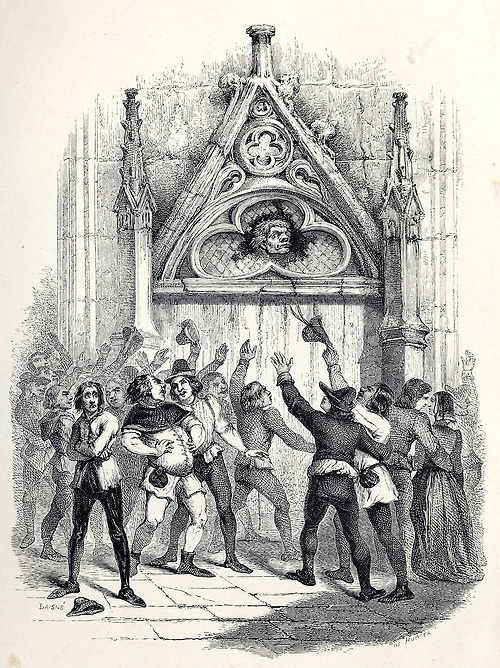
So, as expected with a rowdy crowd of Parisians in a small place, they ignore the play entirely (much to Gringoire's chagrin) and set up a makeshift "window" and take volunteers for the grimacing contest. Gringoire relentless urges the actors to shot their lines over the noise of the crowd but has to resign to the fact it's a hopeless endeavor. While he's mourning the loss of his play's moment with the attention of VIP's the crowd is hooting an hollaring at the parade of grmances made for their amusement. A final grimace appearing in the window ensures his victory with the comments of onlookers:
"Oh! the ugly ape!"
"It is the devil himself!"
"It is Quasimodo, the bell ringer!
"Oh, the ugly hunchback!"
And this is how Hugo introduces the reader to Quasimodo, a reclusive bell-ringer of Notre Dame cathedral. Not only is Quasimodo "miraculously ugly, with a horshoe mouth, a horny lip and full of melancholy" he is deaf. One might think the crowd prone to a twinge of guilt by so blatantly making fun of a man whose face is permanently set in a grimace...but not this crowd. As if a slight breeze blew the hall, ruffling only a few whips of hair and causing momentairly delay, the crowd quickly dismissed this minor detail and crowns him the Pope of Fools, dresses him in the "pasteboard tiara and mock robe" and perches him atop a litter carried by twelve officers of the Fraternity of Fools. Quasimodo has but no choice to be paraded now through the galleries and out into the street.
The end of Book I introduces us to La Esmeralda, who, juding from the reactions of men in her general vicinty, is very easy on the eyes. "This pronouncement (of La Esmeralda) produced a magical effect. All who were in the hall ran to the windows, clambering up the walls to obtain a view. Thunderous applause arose at the same moment from the square." We are left wondering, as Gringoire puts it, "what do they mean (by shouting the name) La Esmeralda? It must surly be Egyptique!"

No comments:
Post a Comment