Can you see it? That tiny white spot on the horizon? That's me; I'm waiving the white flag of surrender. Like a wild animal caught in quicksand, I could not escape the details of Parisian city planning and died a slow death of boredom mixed with lethargy...sorry Victor...
Any suggestions for March's classic?
February 29, 2012

February 26, 2012
Reader's Block
Is it possible to have reader's block? I can't make myself read any more of the The Hunchback of Notre Dame, I just can't do it. Maybe I should just read the Sparknotes instead? Notre Dame de Paris--the Shortcut via Sparknotes. I'm sitting at B&N, no husband or dogs to impose on my time and I'm typing this instead. I read Death Comes to Pemberley in about a day, and that was with sleep and work counted in those hours and it was so easy. Unfortunately, not so easy with this novel. I really want to finish the novel because I don't like to miss a goal once stated...but I hate being forced to read something...even if it's only me forcing myself. Did I read a novel this month? Yes, yes I did; was it a classic? No, not yet at least. My husband and friends tell me to read whatever I want to since it is my blog. I almost rather read my Accounting book again...almost. Three days remain...
On a completely different note, I recently looked at a magazine on the stands directly opposite me and this was it's cover page: Note: as a nutrition educator, I find this disturbing...

On a completely different note, I recently looked at a magazine on the stands directly opposite me and this was it's cover page: Note: as a nutrition educator, I find this disturbing...
February 24, 2012
Intermission--Death Comes to Pemberley
I had to take a break; I had to take a break from reading The Hunchback. I told a co-worker today that I have had a new book sitting on my desk to read for the last three weeks--and I really wanted to read it. It's borrowed from the library, due this Saturday and I can't renew it. Furthermore I found out I was request #168 on the list to get it again. Since I try not to buy books I know I can rent from the library, I had to make an executive decision.
I'm letting the details of Parisian architecture in the later Medieval period rest for a couple days while I read Death Comes to Pemberley, (read more quickly and with a greater desire) a novel intertwining the supposed future lives of Elizabeth Bennet and Fitzwilliam Darcy from Jane Austen's Pride and Prejudice with a murder that occurs within the creepy woodlands on their estate the eve of Lady Anne's Ball. I am a much happier reader at the moment, I must admit. I was becoming caked with mud trudging through the mire of copious details (no offence Hugo). I'm nearly a third of the way through the novel already, voraciously absorbing the Georgian period details I love to learn about.
Just for the fun of it, let's remember the famous lake scene from the 1995 miniseries (that never happened in the book but that skyrocketed Colin Firth's career).
I'm letting the details of Parisian architecture in the later Medieval period rest for a couple days while I read Death Comes to Pemberley, (read more quickly and with a greater desire) a novel intertwining the supposed future lives of Elizabeth Bennet and Fitzwilliam Darcy from Jane Austen's Pride and Prejudice with a murder that occurs within the creepy woodlands on their estate the eve of Lady Anne's Ball. I am a much happier reader at the moment, I must admit. I was becoming caked with mud trudging through the mire of copious details (no offence Hugo). I'm nearly a third of the way through the novel already, voraciously absorbing the Georgian period details I love to learn about.
Just for the fun of it, let's remember the famous lake scene from the 1995 miniseries (that never happened in the book but that skyrocketed Colin Firth's career).
February 23, 2012
Le Cour de Miracles
Dante's seven levels of hell--that's what our poetic protagonist falls into running through (and finding himself lost in) the streets of Paris after recovering from Quasimodo's fist in his face.
Interesting note at this junction: I'm nearly finished with book three of the novel (over 100 pages) and I realized that this book is not at all like the movies we see growing up. Quasimodo has only been mentioned a couple times; this book is about Pierre Gringoire and the architecture of Paris, specifically Notre Dame cathedral. As a matter of fact, I just finished reading an entire chapter dedicated to the architecture of Notre Dame cathedral and Hugo's passionate feelings as to the defacement put upon the structure via time, wars and sovereigns. The next chapter is all about Paris's aerial view and city planning. VERY different from my prior knowledge of the novel.
Pierre ends up in a nasty part of Paris--the Cour de Miracles, so named due to the beggars and thieves who use trickery to feign physical injuries to earn money. Each night after a day of asking for alms these "tramps" living in the Kingdom of Slang take off their mutilated limbs and imbibe till morning. Unfortunately for Pierre, they don't warm to bourgeoisie like him and so he finds himself in a sticky situation; he must perform a simple task. He can either silently steal a coin from a dummy's pocket without making tiny bells ring (that have been sewn to his clothing) or he can be hanged. Poor Pierre--he fails miserably and faces the noose. A moment before his young life is about to be stifled, Esmeralda offers to marry him.
Marry him? Apparently the custom amongst gypsies is to offer a dying man to any woman who will take him. Lucky for him, Esmeralda was in a sympathetic mood; they "break the jug" and it falls to four pieces--the number of years they are to be wed. She takes him home and he's dumbfounded, though still a man, and tries to "make good" on his rights as a husband. She pulls a knife on him, he relents, asks for food and they talk of their families. We learn that Pierre is an orphan taken in by an abbot for the cathedral and has not a penny to his name. Finally, Esmeralda disappears and Pierre finally finds a place to sleep for the night atop an old dresser.

Interesting note at this junction: I'm nearly finished with book three of the novel (over 100 pages) and I realized that this book is not at all like the movies we see growing up. Quasimodo has only been mentioned a couple times; this book is about Pierre Gringoire and the architecture of Paris, specifically Notre Dame cathedral. As a matter of fact, I just finished reading an entire chapter dedicated to the architecture of Notre Dame cathedral and Hugo's passionate feelings as to the defacement put upon the structure via time, wars and sovereigns. The next chapter is all about Paris's aerial view and city planning. VERY different from my prior knowledge of the novel.
Pierre ends up in a nasty part of Paris--the Cour de Miracles, so named due to the beggars and thieves who use trickery to feign physical injuries to earn money. Each night after a day of asking for alms these "tramps" living in the Kingdom of Slang take off their mutilated limbs and imbibe till morning. Unfortunately for Pierre, they don't warm to bourgeoisie like him and so he finds himself in a sticky situation; he must perform a simple task. He can either silently steal a coin from a dummy's pocket without making tiny bells ring (that have been sewn to his clothing) or he can be hanged. Poor Pierre--he fails miserably and faces the noose. A moment before his young life is about to be stifled, Esmeralda offers to marry him.
Marry him? Apparently the custom amongst gypsies is to offer a dying man to any woman who will take him. Lucky for him, Esmeralda was in a sympathetic mood; they "break the jug" and it falls to four pieces--the number of years they are to be wed. She takes him home and he's dumbfounded, though still a man, and tries to "make good" on his rights as a husband. She pulls a knife on him, he relents, asks for food and they talk of their families. We learn that Pierre is an orphan taken in by an abbot for the cathedral and has not a penny to his name. Finally, Esmeralda disappears and Pierre finally finds a place to sleep for the night atop an old dresser.

February 22, 2012
Unique Chapter Titles
My recent reading made me laugh; Hugo is quite creative in his choice of chapter titles. For instance, Chapter IV of book two: "The Unfortunate Consequences of Following a Pretty Girl in the Street at Night." It's specific, that's for sure. Or, how about this one: "From Charybdis into Scylla." What does this mean? Well, Charybdis was a once-beautiful Greek nymph who was turned into a sea monster. On the other side the narrow strait where she lived was Scylla, a second horrible monster with four eyes. Essentially, a sailor in a bind would be between a Charybid and a Scylla...or a rock and a hard place. Bravo Hugo for your creativity! Poor Gringoire, in our story, is the fellow down on his luck, attempting to find a place to rest his weary, ego-deflated head with the failure of his morality play.
Gringoire ends up wandering throughout Paris, unable to return home because he's behind on rent. Driven by a desire to get as far away from the parade of the Feast of Fools, he takes alleyways and shortcuts through some questionable parts of Paris. Hugo uses this time to reflect upon the architecture of Paris and its change since the setting of the novel. He detests the destruction of buildings with the passing of the Renaissance, Bastille Day and most recently the Industrial Revolution. He mourns the loss of great buildings and the character they created.
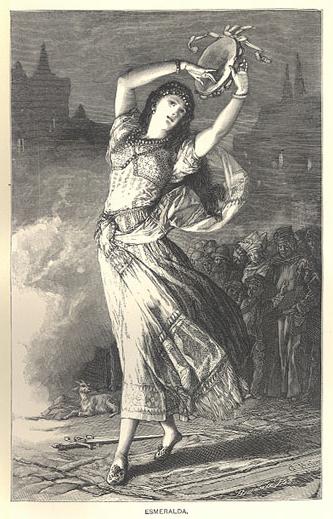
Meanwhile, the Feast of Fools parade has been meandering through the wards of Paris, drawing like a magnet to it thieves, bums and general riff-raff. Quasimodo is still atop his perch, basking in what little notice he's likely ever garnered with revelry in his quiet life. The parade enters a square where Esmeralda is performing with Djali; as expected during this time, Djali is a trianed goat, but an abott in the crowd accuses her of sorcery. The rest of the crowd, however, loves her performance and Gringoire, as expected, is mesmerized by her femninity and exoticism. Esmeralda eventually finishes her performances, collects the coins tossed at her by the crowd and hastily exits to avoid the piercing eyes of the abbott.
Gringoire, continuing on his journey to find a plot of land to rest upon stumbles upon Esmeralda, walking swiftly and deftly through the streets with Djali. He follows her, intrigued by her beauty but also by his curiosity. Esmeralda senses Gringoire's presence and hastens her step but is abruptly cut off by none other than the demenaing abbott and Quasimodo. Quasimodo grabs her, strong as an ox, flattening Gringoire's futile attempt to rescue her with the back of his hand. With Gringoire on the ground and Esmeralda desperately fighting for freedom, the abbot turns to the alley but his escape is stopped by memebers of the Paris police who free Esmeralda and capture Quasimodo. The abbot and Esmeralda run away and Gringoire is left to his wounds in the cold streets of a Parisian gutter.

Gringoire ends up wandering throughout Paris, unable to return home because he's behind on rent. Driven by a desire to get as far away from the parade of the Feast of Fools, he takes alleyways and shortcuts through some questionable parts of Paris. Hugo uses this time to reflect upon the architecture of Paris and its change since the setting of the novel. He detests the destruction of buildings with the passing of the Renaissance, Bastille Day and most recently the Industrial Revolution. He mourns the loss of great buildings and the character they created.
Meanwhile, the Feast of Fools parade has been meandering through the wards of Paris, drawing like a magnet to it thieves, bums and general riff-raff. Quasimodo is still atop his perch, basking in what little notice he's likely ever garnered with revelry in his quiet life. The parade enters a square where Esmeralda is performing with Djali; as expected during this time, Djali is a trianed goat, but an abott in the crowd accuses her of sorcery. The rest of the crowd, however, loves her performance and Gringoire, as expected, is mesmerized by her femninity and exoticism. Esmeralda eventually finishes her performances, collects the coins tossed at her by the crowd and hastily exits to avoid the piercing eyes of the abbott.
Gringoire, continuing on his journey to find a plot of land to rest upon stumbles upon Esmeralda, walking swiftly and deftly through the streets with Djali. He follows her, intrigued by her beauty but also by his curiosity. Esmeralda senses Gringoire's presence and hastens her step but is abruptly cut off by none other than the demenaing abbott and Quasimodo. Quasimodo grabs her, strong as an ox, flattening Gringoire's futile attempt to rescue her with the back of his hand. With Gringoire on the ground and Esmeralda desperately fighting for freedom, the abbot turns to the alley but his escape is stopped by memebers of the Paris police who free Esmeralda and capture Quasimodo. The abbot and Esmeralda run away and Gringoire is left to his wounds in the cold streets of a Parisian gutter.
February 20, 2012
The Fickleness of Humanity
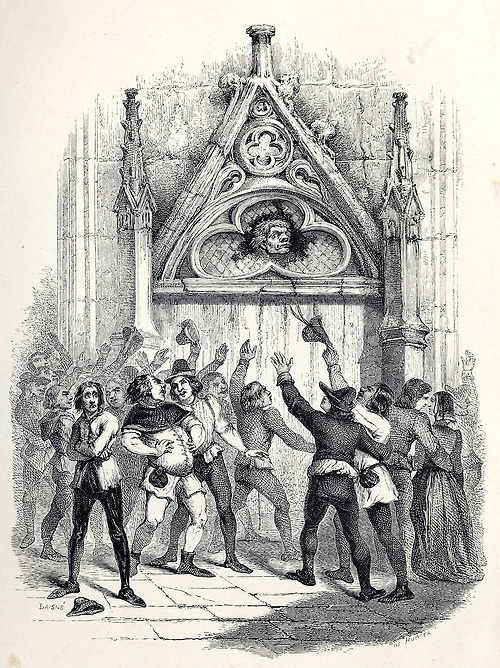
Gringoire, our zealous poet, has little success in trying to turn the crowd's attention back to his morality play once the Flemish dignitaries and the Cardinal enter the Palais de Justice. In fact, the energy of the play peters out in favor of a Flemish celebratory custom, suggested by Coppenhole--a gregarious, boisterous Flemish attendant. This custom? The choosing of a Pope of Fools; this Pope of Fools is decided upon by the crowd; the honor is bestowed upon the person who can conjure up the ugliest grimace through a window or cutout.
So, as expected with a rowdy crowd of Parisians in a small place, they ignore the play entirely (much to Gringoire's chagrin) and set up a makeshift "window" and take volunteers for the grimacing contest. Gringoire relentless urges the actors to shot their lines over the noise of the crowd but has to resign to the fact it's a hopeless endeavor. While he's mourning the loss of his play's moment with the attention of VIP's the crowd is hooting an hollaring at the parade of grmances made for their amusement. A final grimace appearing in the window ensures his victory with the comments of onlookers:
"Oh! the ugly ape!"
"It is the devil himself!"
"It is Quasimodo, the bell ringer!
"Oh, the ugly hunchback!"
And this is how Hugo introduces the reader to Quasimodo, a reclusive bell-ringer of Notre Dame cathedral. Not only is Quasimodo "miraculously ugly, with a horshoe mouth, a horny lip and full of melancholy" he is deaf. One might think the crowd prone to a twinge of guilt by so blatantly making fun of a man whose face is permanently set in a grimace...but not this crowd. As if a slight breeze blew the hall, ruffling only a few whips of hair and causing momentairly delay, the crowd quickly dismissed this minor detail and crowns him the Pope of Fools, dresses him in the "pasteboard tiara and mock robe" and perches him atop a litter carried by twelve officers of the Fraternity of Fools. Quasimodo has but no choice to be paraded now through the galleries and out into the street.
The end of Book I introduces us to La Esmeralda, who, juding from the reactions of men in her general vicinty, is very easy on the eyes. "This pronouncement (of La Esmeralda) produced a magical effect. All who were in the hall ran to the windows, clambering up the walls to obtain a view. Thunderous applause arose at the same moment from the square." We are left wondering, as Gringoire puts it, "what do they mean (by shouting the name) La Esmeralda? It must surly be Egyptique!"

So, as expected with a rowdy crowd of Parisians in a small place, they ignore the play entirely (much to Gringoire's chagrin) and set up a makeshift "window" and take volunteers for the grimacing contest. Gringoire relentless urges the actors to shot their lines over the noise of the crowd but has to resign to the fact it's a hopeless endeavor. While he's mourning the loss of his play's moment with the attention of VIP's the crowd is hooting an hollaring at the parade of grmances made for their amusement. A final grimace appearing in the window ensures his victory with the comments of onlookers:
"Oh! the ugly ape!"
"It is the devil himself!"
"It is Quasimodo, the bell ringer!
"Oh, the ugly hunchback!"
And this is how Hugo introduces the reader to Quasimodo, a reclusive bell-ringer of Notre Dame cathedral. Not only is Quasimodo "miraculously ugly, with a horshoe mouth, a horny lip and full of melancholy" he is deaf. One might think the crowd prone to a twinge of guilt by so blatantly making fun of a man whose face is permanently set in a grimace...but not this crowd. As if a slight breeze blew the hall, ruffling only a few whips of hair and causing momentairly delay, the crowd quickly dismissed this minor detail and crowns him the Pope of Fools, dresses him in the "pasteboard tiara and mock robe" and perches him atop a litter carried by twelve officers of the Fraternity of Fools. Quasimodo has but no choice to be paraded now through the galleries and out into the street.
The end of Book I introduces us to La Esmeralda, who, juding from the reactions of men in her general vicinty, is very easy on the eyes. "This pronouncement (of La Esmeralda) produced a magical effect. All who were in the hall ran to the windows, clambering up the walls to obtain a view. Thunderous applause arose at the same moment from the square." We are left wondering, as Gringoire puts it, "what do they mean (by shouting the name) La Esmeralda? It must surly be Egyptique!"
February 16, 2012
"Monstrously Overburdened with Details"
"Hugo's descriptions of Parisian places is monstrously overburdened with details." If you recall from my last post (which, yes, was over a week ago) you'll recall this quote from the translator on Hugo's architectural flair for descriptive-ness. Let's just say she was acutely accurate; however, I will say that I have excellent fodder for creatively imagining the setting in which this novel takes place.
I've trudged through a mire of extensive detail of the Palais de Justice, (below) the central figure of the first few chapters of The Hunchback. Our narrator describes for us a cacophony of Parisian plebs in celebratory mood as it's the Feast of Fools, a day in the life of medieval Paris that allows the masses to sarcastically insult the bourgeoisie.
All are gathered to the great hall of the palace to watch a "morality play." Hugo provides a thorough description of the play's author, Pierre Gringoire, a "blonde, tall and slender, pale, still young, with sparkling eyes and smiling lips." Hugo gives ample text to miniature stories happening simultaneously--Pierre charming two nubile French maids, a beggar annoying the play's actors, the pompous entrace of the Cardinal and the Flemish dignatries (for which the play is being performed) and descriptions of the energetic young men shouting inflammatory comments to the clergy, much to the audience's cheer.
I will admit that in only a few pages I already have a vivid and detailed image of the setting for this novel. I will also admit it takes some energy to make it through the details!

I've trudged through a mire of extensive detail of the Palais de Justice, (below) the central figure of the first few chapters of The Hunchback. Our narrator describes for us a cacophony of Parisian plebs in celebratory mood as it's the Feast of Fools, a day in the life of medieval Paris that allows the masses to sarcastically insult the bourgeoisie.
All are gathered to the great hall of the palace to watch a "morality play." Hugo provides a thorough description of the play's author, Pierre Gringoire, a "blonde, tall and slender, pale, still young, with sparkling eyes and smiling lips." Hugo gives ample text to miniature stories happening simultaneously--Pierre charming two nubile French maids, a beggar annoying the play's actors, the pompous entrace of the Cardinal and the Flemish dignatries (for which the play is being performed) and descriptions of the energetic young men shouting inflammatory comments to the clergy, much to the audience's cheer.
I will admit that in only a few pages I already have a vivid and detailed image of the setting for this novel. I will also admit it takes some energy to make it through the details!
_June_2010.jpg)
February 8, 2012
Course Adjustment
I haven't even started reading Les Miserables yet; I'm not feeling it this month. So I'm making an executive decision: I've decided to read The Hunchback of Notre Dame instead. Still Hugo, still French but (and thankfully) shorter in length and not the weight of a small child. I know for certain I have yet to read The Hunchback, unlike my ambiguity on whether I read Les Miserables.
I find the following statement from this edition's translator both encouraging and intriguing: "I have made the novel more accessible to a contemporary audience, but I have also made the original translation with all its mistakes and prejudices disappear...(the previous translation) was hasty and prudish to the extreme. The reader will be more shocked by Hugo's obvious prejudices against minorities. Architecture is the real hero of the novel as Hugo's descriptions of Parisian places is monstrously overburdened with details."
I have a feeling this translation of the novel will not follow Disney's idealistic interpretation...

I find the following statement from this edition's translator both encouraging and intriguing: "I have made the novel more accessible to a contemporary audience, but I have also made the original translation with all its mistakes and prejudices disappear...(the previous translation) was hasty and prudish to the extreme. The reader will be more shocked by Hugo's obvious prejudices against minorities. Architecture is the real hero of the novel as Hugo's descriptions of Parisian places is monstrously overburdened with details."
I have a feeling this translation of the novel will not follow Disney's idealistic interpretation...
February 2, 2012
Les Miserables...or Mes Miserables?
Would it be a sacrilege to watch Les Miserables before I read the novel? Yes, I know, it would be; I just wish I could remember if I read it in school or not--and that is why I should read it. It's a beast of a novel unabridged; perhaps I should try and find a large print version? No, that won't work...then it will only be longer!
What if I were to sing all the songs from Les Miserable, the musical in stead? I sang those in choir years ago. I would much prefer that...can you tell I'm procrastinating? February 2 and I haven't yet started to read it. That means I only have 27 days to read it; this means I would need to read an average number of 54 pages a day. Yikes. Well, let's hope I become engrossed in the novel and don't notice pages 100, 200...
Did you know there is a "Forever Young" official Les Miserables Tour website? Les Miserables. I'm more excited that there is a remake set to arrive in 2012 starring Russel Crowe and Hugh Jackman (yes, please) Les Miserables 2012. Though I have to give props to Liam Neeson, Claire Danes and Geoffrey Rush for the 1998 version.

What if I were to sing all the songs from Les Miserable, the musical in stead? I sang those in choir years ago. I would much prefer that...can you tell I'm procrastinating? February 2 and I haven't yet started to read it. That means I only have 27 days to read it; this means I would need to read an average number of 54 pages a day. Yikes. Well, let's hope I become engrossed in the novel and don't notice pages 100, 200...
Did you know there is a "Forever Young" official Les Miserables Tour website? Les Miserables. I'm more excited that there is a remake set to arrive in 2012 starring Russel Crowe and Hugh Jackman (yes, please) Les Miserables 2012. Though I have to give props to Liam Neeson, Claire Danes and Geoffrey Rush for the 1998 version.
Subscribe to:
Comments (Atom)